Dallas · Garments & newspapers
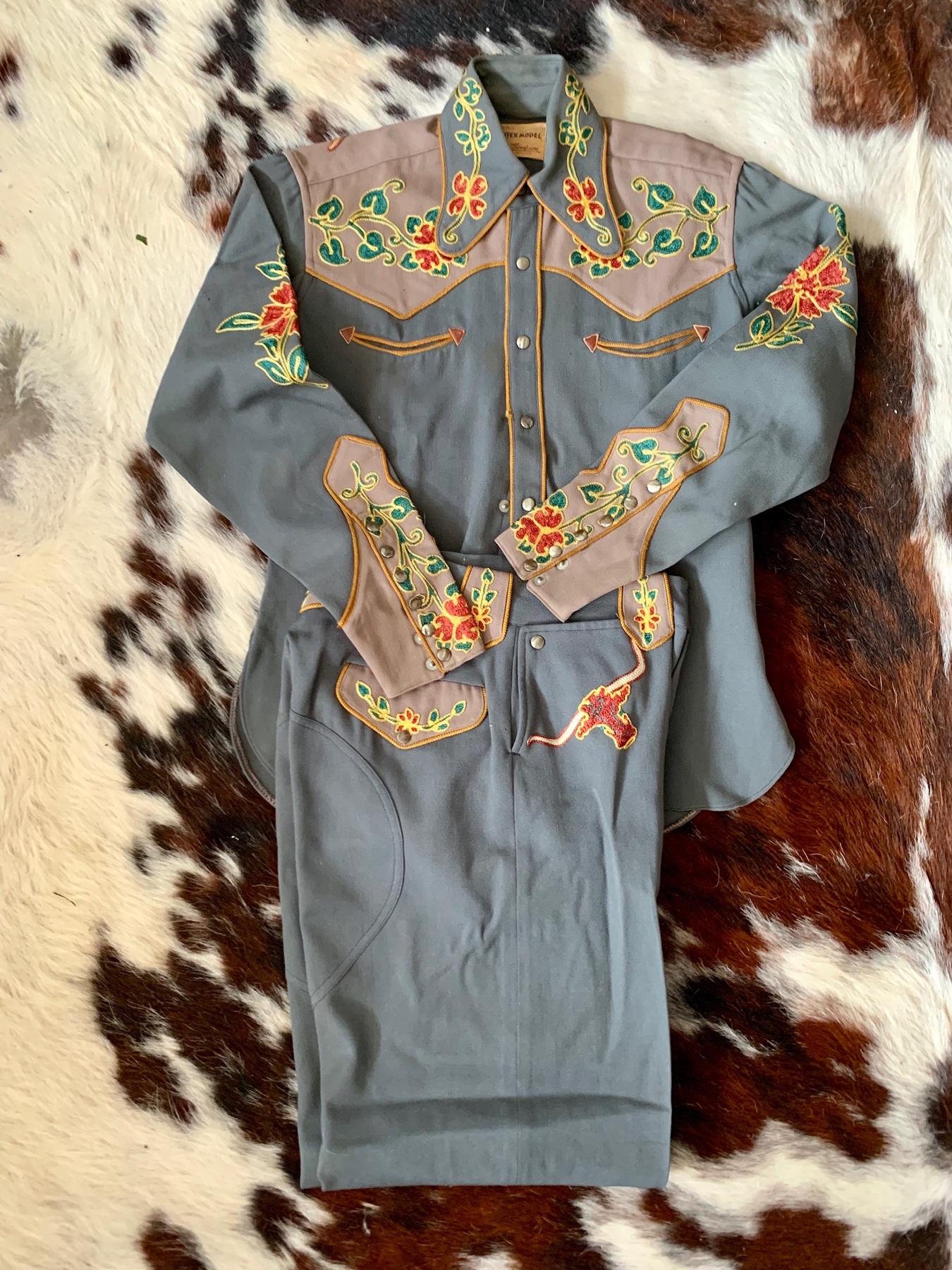
Frontex: a Dallas shirt on its way to the Riviera.
A Dallas name in cloth and print
Flowers, piping and a Dallas label.
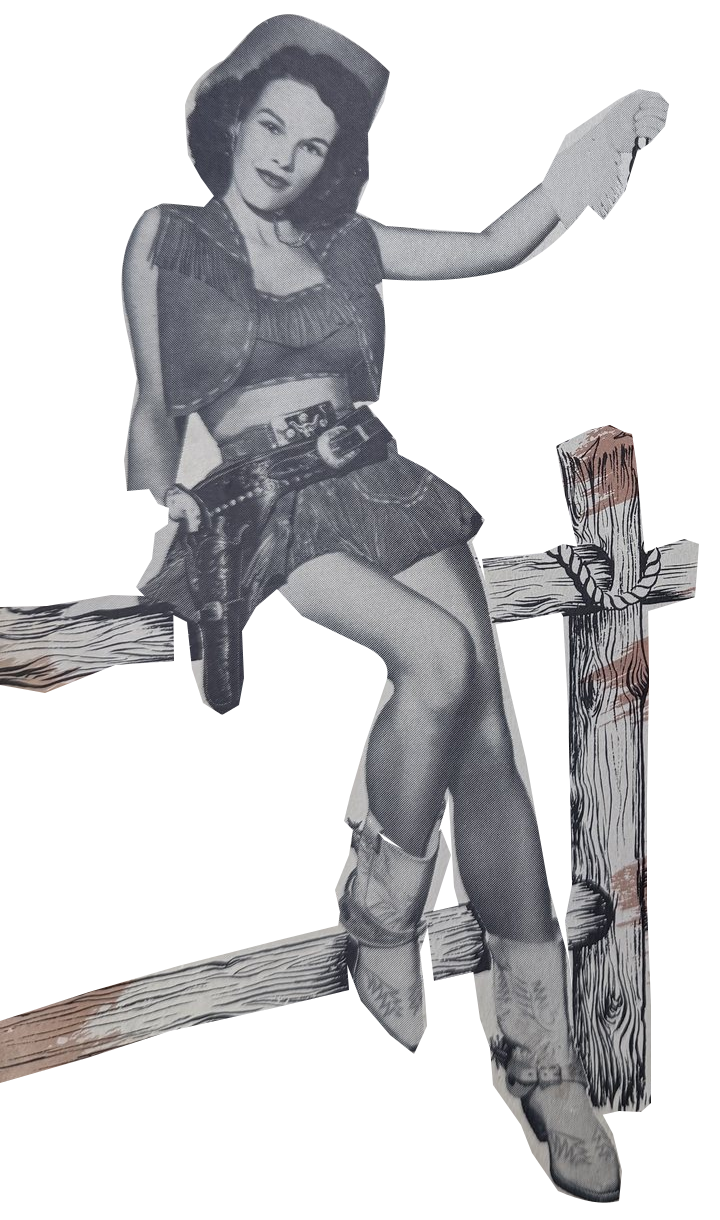
On 20 June 1952, an Associated Press report in the Big Spring Daily Herald described seven Texas models preparing to travel to the French Riviera for Texas Week. Their clothes were “cowboy regalia,” the story said: specially made Wild West costumes averaging $1,000. The report named their maker as “Frontex of Dallas,” then offered a compact picture of the firm’s work: it “runs up tasty $100 shirts and such for rodeo boys and girls.” A. Harris and Company, the article separately reported, was paying the delegation’s bill.
Those are the newspaper’s figures and descriptions, not an invoice or a surviving costume record. But they make a vivid opening because the story catches Frontex at the meeting point of two markets: the everyday shirt described for rodeo customers and the elaborate outfit prepared for an international Texas spectacle. One Dallas firm, as the AP presented it, could dress both. The delegation’s clothes were made for a trip that turned Texas identity into a public performance thousands of miles from home.
The article does not name the seven models, describe the costumes’ construction, or identify a specific surviving garment. It also does not say that A. Harris made, sold or stocked the clothes; its role in this account was to pay for the delegation. Even so, the report gives us something unusually tangible for a commercial label: a dated account of work attributed to a Dallas firm, a stated market for its shirts, and a public event in which costume carried the idea of Texas abroad.
What survives in a museum
Another Frontex story comes not from a newspaper but from a shirt preserved by the Texas Fashion Collection at the University of North Texas. Accession 1983.024.056 is catalogued as a Western-style shirt, with creation date unknown. The institution’s record describes maroon wool, beige accents and green piping; it notes large white-and-green floral motifs in chain stitch, curved collar points and cuffs with six snaps. The catalogue lists “Frontex Irby Thompson, Inc.” as creator/manufacturer.
The object has the kind of detail that makes a catalogue record feel almost like a close conversation with the maker. The green line of piping does more than outline the shirt: it gives the beige and maroon a route around the body. The large chain-stitched flowers refuse the idea that Western clothing had to be plain in order to be wearable. Six snaps draw the same decorative vocabulary down to the cuff, where the garment’s finish meets the movement of a working hand.
That is a reading of the object’s visible design, not a record of who drew it or who stitched it. The museum’s catalogue preserves the material description and its creator field; it does not give a commission history, identify a wearer, date the shirt, or name the individual workers responsible for its embroidery and assembly. The institutional attribution belongs to this accessioned shirt. It cannot stand in for a complete Frontex company history.
The photographed label introduces a further naming question. The visible lines read “Tailored,” “CASUALS,” and “by Frontex Co.” The catalogue’s creator field says “Frontex Irby Thompson, Inc.” The label is evidence on one shirt; the catalogue field is the museum’s attribution. A newly located court opinion names Frontex Company, Inc. and Irby-Thompson Company, Inc. separately in a 1947 agreement. That makes it especially important not to read the museum field as a single verified legal name or assume the label and catalogue record describe the same corporate entity. [UNT-FRONTEX-1983.024.056; TAX-1954-THOMPSON, provisional]
A second label, not yet a bridge
A seller-photographed beige shirt offers another visible label: “AN ORIGINAL FRONTEX MODEL / IRBY THOMPSON, INC. / DALLAS,” with a separate 12-L size tab. The shirt’s front shows curved chest pockets with triangular ends. Those details can be read in the listing photographs. The seller’s proposed 1940s–50s date, material description and business attribution remain seller claims.
The label is tempting because “Irby Thompson” also appears in the museum’s creator field. The court record now gives those names a documented business context, but it does not date either shirt or identify which corporation made one. The seller’s shirt and the UNT accession have different custody histories and different labels. The seller image does not date the UNT shirt, and the museum record does not authenticate the seller’s garment.
This is where a careful visual history earns its keep. A label can give us words and a place to investigate. A seam or a pocket can show us what the camera records. Neither, by itself, tells us who owned the business, where a garment was made, or how the name travelled between shop, label, performer and customer.
Two company names in a 1947 agreement
A business record can change the questions without settling the garments. In a 1954 U.S. Tax Court opinion, the court reproduces parts of a December 1947 property agreement. The agreement names Frontex Company, Inc. and Irby-Thompson Company, Inc. as separate corporations among businesses in which J. Sidney Thompson held an interest. A third named concern, Woolen Uniform Company, Inc., appears beside them. The opinion is about the tax treatment of a settlement, not the history of Western shirts, but it preserves the company names and a financial connection in a dated legal record. [TAX-1954-THOMPSON, provisional]
The distinction is useful. The UNT catalogue combines Frontex and Irby Thompson in one creator field; the court-reproduced agreement uses two corporate names. Neither source explains whether Frontex was a brand, a separate manufacturer, a sales company, or a changing business arrangement behind the museum shirt. Nor does the agreement connect the 1952 Riviera costumes to a particular corporation or workshop. It does give us a better question for the next records search: which name appears on the order, payroll, invoice, or garment label at each date? [TAX-1954-THOMPSON, provisional; UNT-FRONTEX-1983.024.056; CWW-TTU-1952-FRONTEX-AP]
What the paper trail can—and cannot—say
The court agreement, June 1952 report and two garments make Frontex more than a name on a label. The 1947 document names separate businesses connected through Thompson's interests. A contemporary newspaper later attributes an international delegation’s costumes to “Frontex of Dallas” and describes the firm’s shirts for rodeo boys and girls. One museum accession preserves a striking Western shirt with a Frontex-related catalogue attribution, an unknown date and a visible “Frontex Co.” label. A seller-photographed object carries a different Irby Thompson label. Each source contributes something distinct; none supplies the whole chain. [TAX-1954-THOMPSON, provisional; CWW-TTU-1952-FRONTEX-AP; UNT-FRONTEX-1983.024.056; CWW-SELLER-2026-FRONTEX-ETSY]
We do not yet have a dated catalogue sequence, articles of incorporation, production documents, securely dated retail advertisements, or a source that joins the newspaper’s “Frontex of Dallas” to either garment’s naming form. The court record names corporations and an interest held in them, but cannot supply their full ownership, manufacturing roles or later continuity. Nor can the 1952 AP story establish the actual price of every shirt or show how many were made. The $100 and $1,000 figures are part of one report about shirts and a particular group of costumes, not a price history.
The picture that remains is still lively. A court opinion preserves the names of two businesses in 1947. Five years later, a Dallas firm was described as dressing rodeo customers and making costly costumes for a Texas delegation headed to the Riviera. An undated accessioned shirt carries Frontex in its catalogue attribution and label. Between those points lie records we have not yet found: orders, payroll, advertisements and photographs that could tell us who made the clothes, how the businesses worked, and what a customer saw when a Frontex shirt came off the counter.
For now, Frontex enters this history through a legal record, a newspaper’s report of Texas regalia made for an overseas stage, and a preserved shirt whose embroidery still holds the eye. They do not prove one continuous company story. They give us a reason to keep looking—and a more exact idea of what the next document needs to answer.
Stay with the details.
Sources & further reading
- Dorothy Roe / Associated Press, “Texas Models Plan Invasion Of Riviera,” *Big Spring Daily Herald*, 20 June 1952, p. 7
- University of North Texas Texas Fashion Collection, Western Style Shirt, 1983.024.056
- TimebombVintageShop, Frontex listing 4520330412, Etsy
- University of North Texas Texas Fashion Collection, Western Style Shirt, 1983.024.056
- Thompson v. Commissioner, 22 T.C. 275 (12 May 1954), hosted opinion transcription — provisional