Ranchwear · The retail record
H Bar C.
A Western wardrobe at the retail counter
A name woven into the wardrobe.
In March 1949, a reader of the Muleshoe Journal could meet H-Bar-C in the middle of a full-page invitation to dress for the Muleshoe Fat Stock Show. Cobb’s called its spread “Western Clothes.” Stetson Open Road hats and Nocona boots framed the offer; in between, a ranchwear panel promised clothes “ready for action . . . or relaxation.” The retailer named “our shirts, frontier pants, and jackets by H-Bar-C,” and described them as “Tailored by famous H-Bar-C.”
That phrasing carries the confidence of a shop window. It also gives us something firm to begin with: by 1949, Cobb’s was presenting H-Bar-C to its readers as a name attached to shirts, pants and jackets. The advertisement does not tell us which company made them, where they were cut and sewn, what they cost, or how many Cobb’s stocked. “Famous” is the store’s sales language, not a measurement we can verify. But the ad does show how the name was meant to work for a customer. H-Bar-C sat among familiar pieces of a Western outfit, on a page that turned clothes into a ready-made picture of how to appear at a public gathering.
The gathering matters. This was not a maker’s catalogue page sent to a distant specialist; it was a local shop asking its neighbours to dress for the Fat Stock Show. A hat, a boot and a H-Bar-C jacket became parts of one suggested appearance, even though the page says nothing about the factories or hands behind them. That is how a commercial label enters a town’s visual life: beside an occasion and beside other things a person might buy. The page documents an invitation, not what the crowd actually wore.
Shirts, pants, suits: the name broadens
Three years later, Addington’s Western Store in Pampa placed H Bar C under the heading “Western Wear Suggestions.” Its small New Year’s Eve advertisement lists H Bar C shirts, pants and suits alongside Western hats and named boot lines. It is a modest notice on a contest page, but it quietly changes the scale of the story. H Bar C is no longer represented by one panel’s shirts, frontier pants and jackets; a Texas retailer gives the name three garment categories.
In August 1953, during Big Spring’s rodeo week, Prager’s Men’s Store made the range more explicit. Its “Howdy Visitors!” advertisement promised a roundup of Western wear for men, women and children. The list names H-Bar-C shirts, suits and pants, and sets H-Bar-C shirts beside Tem-Tex and California Ranchwear shirts. The store’s page is a snapshot of its own pitch, not a supplier list or a map of the companies behind the names. Still, this is a telling commercial setting: the shopper encountered Western clothing as a coordinated field of named options, gathered under one local roof for the week when the town turned toward the rodeo.
The names do not become interchangeable just because the retailer printed them together. Tem-Tex, California Ranchwear and H-Bar-C each need their own record. The ad tells us what Prager’s chose to put on its page; it does not identify a common factory, owner, designer or route from maker to store. That restraint matters. In commercial clothing, proximity in an advertisement can be part of the sales arrangement without being proof of a corporate relationship.
Other advertisements make the retail setting visible from different angles. A March 1952 Lubbock clearance panel places H-Bar-C within a grouped sequence of Western-shirt names and prints a price range for the store’s offer. A 1956 Salem, Oregon, Army-Navy Surplus ad groups H Bar C with Levi’s and Tex-Son beneath “Complete Line of Authentic Western Wear,” followed by the general words “Shirts and Pants.” These are not a clean distribution map: the Salem panel does not assign a garment or stock quantity to any one name. But taken with the Texas notices, they show the label appearing in distinct retail environments, from a Fat Stock Show page to rodeo-week shopping and a Western-wear department in Oregon.
Read the four pages in order and the change is in the setting, not a proved change inside the company. Muleshoe sells a show-day outfit in 1949. Lubbock places the name among clearance shirts in 1952. Big Spring gathers named garments for rodeo visitors in 1953. Salem puts it in an Army-Navy store’s Western-wear department in 1956. A label could be advertised at a local celebration, in a bargain panel and beside other brands without those pages telling us who made the garments. The retail history is already varied; it does not need an invented factory story to become interesting.
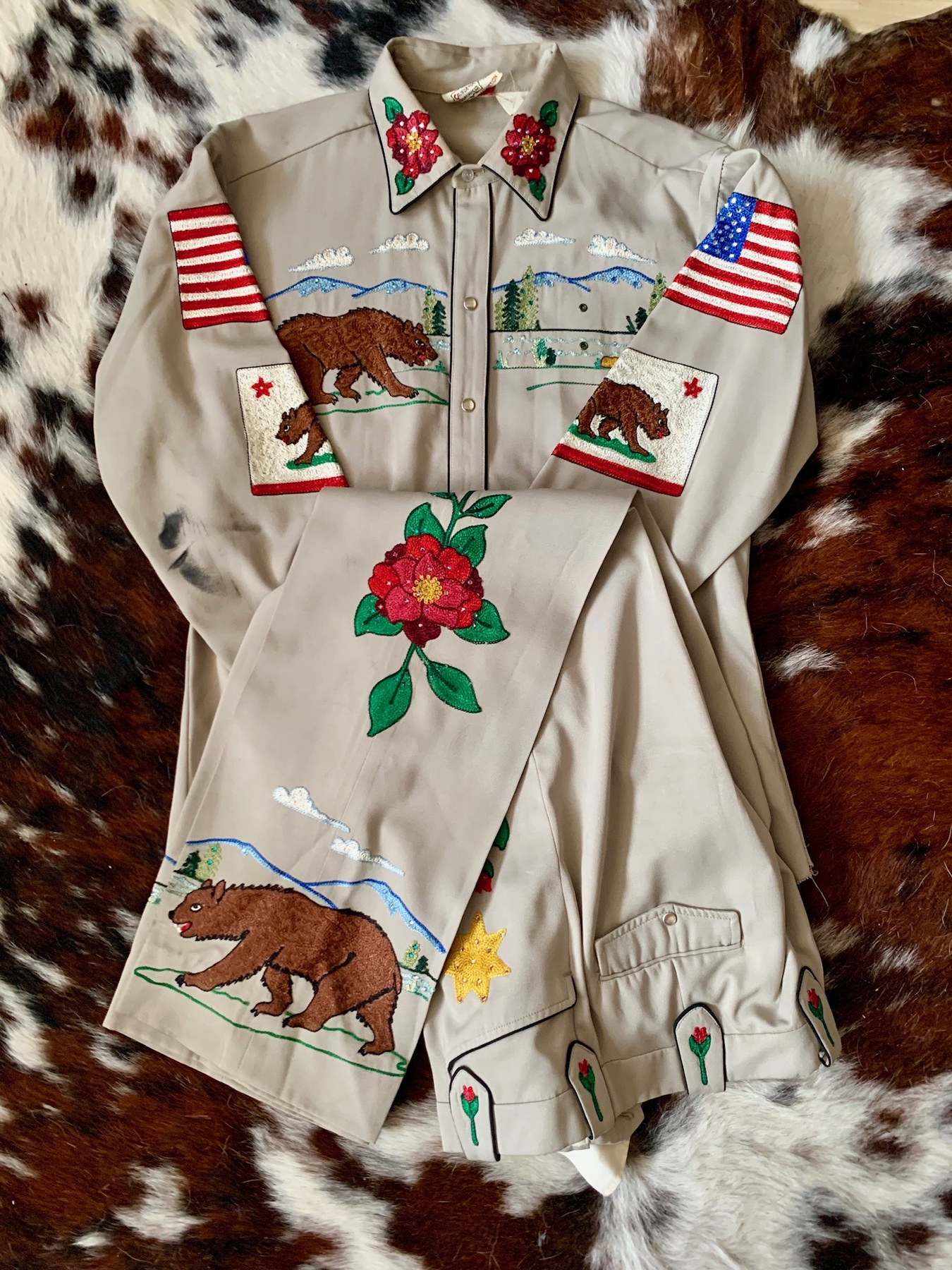
One more page deserves a place in the visual story, with a label attached to its uncertainty. Western Horseman’s 2026 feature reproduces an H Bar C advertisement and captions it “WH February 1953.” The pictured page calls an adult-and-child outfit the “Gambler Striped Western Shirt and Pants Set,” uses the phrase “Good Pards,” and prints Halpern & Christenfeld, Inc. with New York, Los Angeles and Denver addresses. Those details make the image an unusually rich lead into how the brand pictured itself. But the reproduction is not the original issue, and its printed page has no legible date or page marker. Until we inspect that issue or find an independent catalogue record, the February 1953 date belongs to the 2026 feature’s caption—not to a verified period citation.
A name in a government register
The later trademark record asks a different question from the retailer’s page. The Canadian Intellectual Property Office lists the H BAR C word mark under Halpern & Christenfeld, Inc., with a New York address. Its record gives a September 1975 filing and December 1976 registration for a range of ranchwear-styled clothing. It also prints a claim of Canadian use since at least 25 January 1965. That last date is the applicant’s reported use, not independent proof of a sale or a surviving garment from that day. The registration identifies a legal owner of that Canadian mark at a documented point; it does not tell us who cut the shirts Prager’s advertised two decades earlier.
That is why the pages should not be forced into a single company legend. The advertisements tell us how stores used the H Bar C name before shoppers; the registry records a particular claim and owner in a later jurisdiction. Each can be exact without answering the other’s questions. The workers, catalogue sequence, production sites and particular garments between those records still need to be found.
The label, the company, the life still to recover
The records collected so far allow a reader to follow H Bar C across a series of printed encounters: Cobb’s in Muleshoe in 1949; retailer notices in Pampa, Lubbock and Big Spring in the early 1950s; a grouped Western-wear offer in Salem in 1956; and a Canadian trademark registration from the 1970s. The kinds of evidence change with the years. A store’s advertisement documents what it offered readers; the later registry documents who held a named Canadian mark and what use its applicant claimed.
This is a history of a name’s documented commercial life, not yet a complete corporate biography. We do not yet have a verified founding account, a securely sourced full company chronology, factory or workroom records, a catalogue sequence with a confirmed date, named designers or workers, or a matched garment that can connect a printed design to a maker and production record. A present-day H Bar C history offers a useful route into those questions, but it is a corporate retrospective without the underlying citations needed to establish its historical claims here. Its narrative belongs in the research queue until independent records can carry it. The U.S. assignment and an apparent paired-brand advertisement from March 1981 could add a later chapter after direct original-page inspection; they are not used here to infer a 1950s relationship.
That unfinished part is not a reason to treat H Bar C as a footnote. At Cobb’s, the name stood between a Stetson hat and Nocona boots on a page for the Muleshoe Fat Stock Show. Addington’s listed suits in Pampa; Prager’s placed the line beside other Western names for Big Spring’s rodeo visitors; an Oregon surplus store grouped it with Levi’s and Tex-Son. The retailers were not offering a factory history. They were showing customers how to assemble a public Western appearance from named things on a local counter.
That is the story these pages can tell. The labels met in shops and advertisements, though the pages do not establish whether their makers, workers or owners were connected. A printed offer could carry H Bar C’s name from town to town without showing where any garment was sewn; it cannot tell us who bought one or wore it into a rodeo crowd. For that we still need the clothes, their labels, the people who kept them and the records of the business behind the name.
Stay with the details.
Sources & further reading
- Canadian Intellectual Property Office, H BAR C, application 0389524 / registration TMA217948
- El Centro Store, “Quitting Business Sale,” The Roundup, 28 March 1952
- University of Oregon Libraries, *Oregon Statesman*, 7 September 1956, p. 26
- Prager’s Men’s Store, “Howdy Visitors!”, Big Spring (Texas) Herald, 5 August 1953
- Cobb’s, “Western Clothes,” The Muleshoe Journal (17 March 1949)
- Addington’s Western Store, The Pampa Daily News, 31 December 1952
- Laurel Witt, “From Trendy to Timeless: Decades of Cowboy Cool,” Western Horseman, 25 February 2026
- Reagan Ray, ‘Western Clothing Labels,’ 12 December 2017